Not sure yet? Read the first three days free →

A 31-day psychology workbook and guided journal

Try not to think of a white bear.

You just did. That is Day 01. Thirty more follow, one for each day of the month, each with a finding from psychology and the questions that turn it into something you can use.

01

Read the idea

One surprising finding and the research behind it.

02

Make it yours

A few questions that turn the idea into something you can use today.

03

Keep what sticks

At the end of the month, pick the three ideas worth keeping.

Why this book exists

I wrote the one I needed
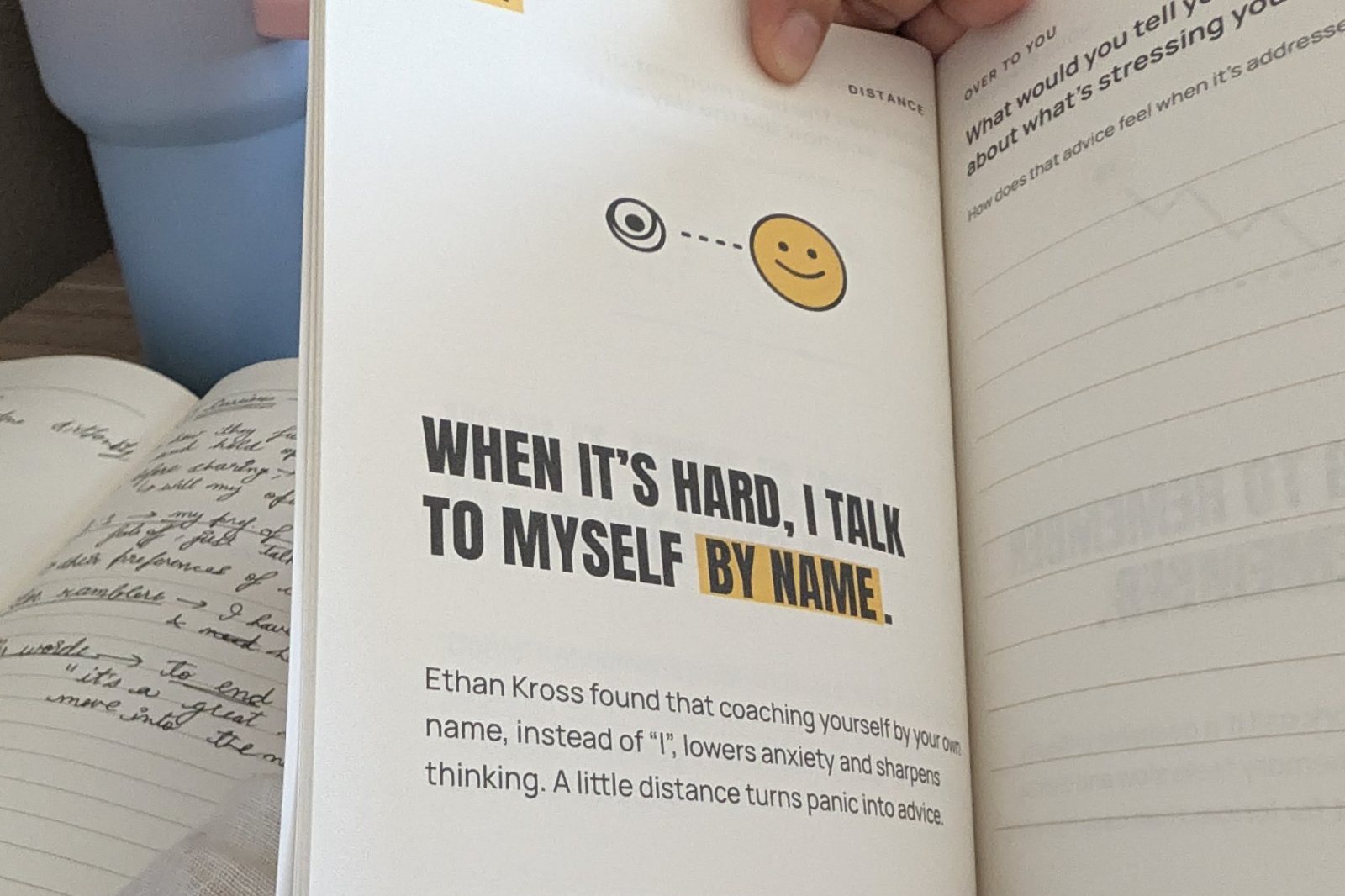
Day 04 of the book held open next to a handwritten journal
Still the same habit, my own journal open next to it.

I am the problem. I bring unhappiness to everyone around me.

I believed that for most of a year. I had moved to Seattle with no friends or community there yet. The days got shorter and darker. Work was turning toxic. Then a visit home brought conflicts that hit hard, and that one thought slowly took over everything else.

I started working with a therapist and a coach. They took deep ideas from psychology and philosophy and broke them into small steps I could actually follow. Most of them began with a simple question I answered in a journal, a few lines at a time.

Writing helped me see what I couldn’t see from the inside. I wasn’t the problem. It was a cloudy sky, and I was standing under it.

Behind it was all the energy, drive and curiosity I had forgotten I carried. Within a few months I changed jobs and started building my own company. I began working out, meditating, going camping. I could look in the mirror and see who I wanted to be.

Along the way I tried CBT, Stanford’s Designing Your Life coaching and an MIT program on overcoming perfectionistic behaviors. Journaling became a habit. Friends would ask who gave me my prompts. Usually I wrote them myself, and I still do. On a hard day I pick up a pen and ask myself the question that fits.

This book holds the ones that helped me most. If you are where I was, you are not lost. You are in a phase, and phases pass.


The first copy

Months on a screen. Then this.

The front cover of Don’t Think of a White Bear held up in daylight
The front, in daylight.
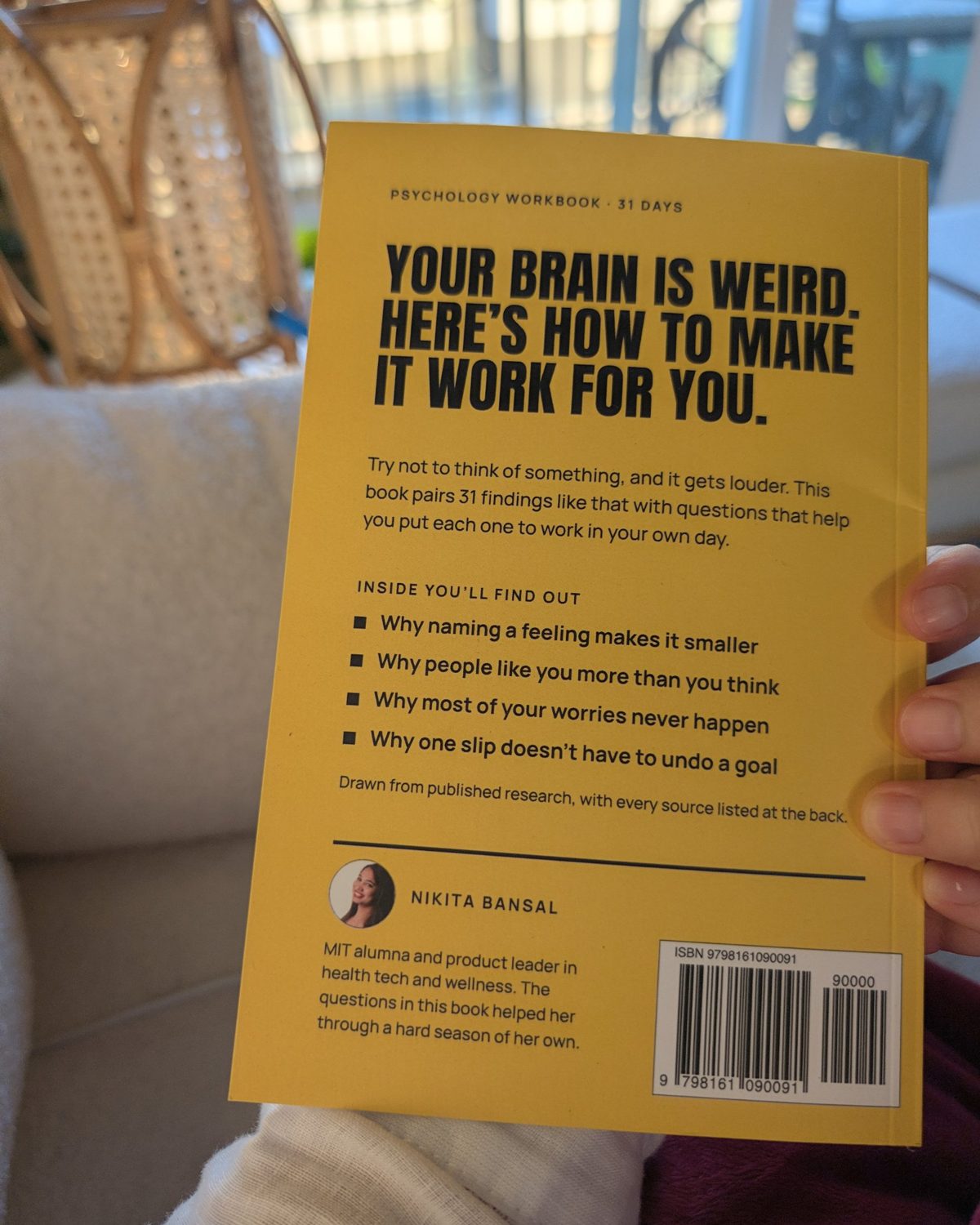
The back cover, listing four of the findings inside the book
And the back, if you read those first.

Questions

Before you buy

Still wondering something? Ask me.

What is Don’t Think of a White Bear about?

Don’t Think of a White Bear is a 31-day psychology workbook and guided journal by Nikita Bansal. Each day gives you one surprising finding about how the mind works, such as why trying not to think about something makes you think about it more, followed by a few questions that help you apply it to your own life.

Who is Don’t Think of a White Bear for?

It is for curious people who want more out of their own mind. Deep thinkers, noticers, people who like a good question and want to understand why they do what they do. You do not need a problem to fix or any background in psychology. You need an appetite for finding out something true about yourself.

Is it a book you read or a journal you write in?

Both. Every day has a short read on one side and writing space with questions on the other. You can read it straight through, but it is designed to be written in. The paperback has a 5.5 by 8.5 inch trim and a color interior with room to write by hand.

How much time does each day take?

About ten minutes. One page to read and one page to answer. Some days you will write two lines and some days you will fill the page. Both are fine.

Do I have to do all 31 days in a row?

No. The days are numbered but not dated, so you can skip a day and pick it up later without falling behind. Nothing in the book depends on having done the day before.

Is the psychology in the book based on real research?

Yes. Each of the 31 findings comes from published psychology research, and the book lists its sources at the back so you can read the original studies. The book explains the findings in plain language rather than academic terms.

How is this different from a blank guided journal?

A blank journal gives you a prompt and leaves you to it. Don’t Think of a White Bear gives you a specific finding about how your mind works first, so the questions you answer have something to push against. You are not starting from an empty page.

Is this book therapy, or a replacement for it?

No. It is a book for everyday reflection, not a replacement for professional care. If you are struggling, please reach out to a professional. In the US you can call or text 988 any time.

How many pages is Don’t Think of a White Bear?

It is 80 pages, in paperback, with a color interior. There are 31 day spreads, a contents page, a place to record the ideas worth keeping, and a sources section.

Who wrote Don’t Think of a White Bear?

Nikita Bansal, a product manager and writer based in San Francisco. She wrote it during a period when writing was the thing that helped her see what she could not see from the inside.

Does the book make a good gift?

Yes, especially for the person who reads widely and likes thinking for its own sake. It gives them something to do rather than advice to follow, so it works as a gift for anyone starting something new or simply curious about how their own mind works.

Where can I buy Don’t Think of a White Bear?

It is available on Amazon in paperback. You can also leave your email on this page to hear about the next book.

Try it first

Three days, free.

The intro and the first three days as a PDF. Print it, write on it, and see whether the questions do anything for you before you spend a cent.

Day 01 is the white bear. Day 02 is naming what you feel. Day 03 is why the ending of a day decides how you remember it.

The PDF opens on the next page. I'll also write when the next book is ready. Unsubscribe any time.

Say hi

Which day stuck with you?

Tell me what worked, what didn’t, or just say hello. I read every message.